
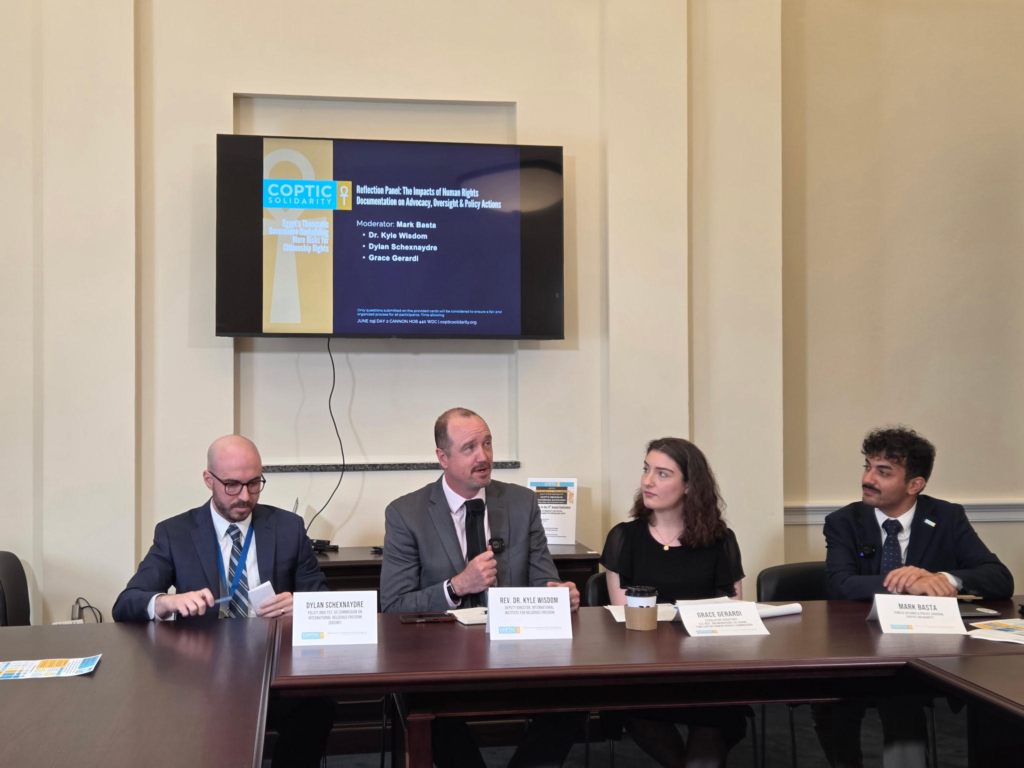
On June 9, IIRF deputy director Kyle Wisdom had the privilege of joining Coptic Solidarity in Washington, D.C., for the launch of CoptWatch, a new database initiative documenting violations against the Coptic community in Egypt. The event brought together a distinguished panel, including representatives from the U.S. Commission on International Religious Freedom (USCIRF) and the Tom Lantos Human Rights Commission, reflecting the seriousness with which policymakers and advocates are approaching this effort.
CoptWatch is an encouraging new initiative, and it naturally resonates with the IIRF as our own Violent Incidents Database (VID) served as one of the inspirations for this effort. Wisdom participated in the panel as a respondent, speaking from his experience in building and using the VID as a data tool to support religious freedom advocacy.
Following (with minor editing for this format) are the remarks Wisdom prepared for the CoptWatch panel discussion.
Advocacy for influence
Capturing data about what is happening in situations where religious freedom faces threats allows advocates to bring reality into the room as we seek to influence political leaders and policymakers. Right and wrong can frequently get lost in narrative wars and power imbalances. Those in power can articulate narratives that reinforce the status quo. Indisputably, governments have the clearest power and the loudest voice. Minority groups must use their opportunities for influence judiciously, and they typically do not have the resources to develop and propagate competing narratives. Targeted stories and information on specific areas in winnable arenas offer the best opportunities for influence.
Broader data collection and presentation can help us move beyond anecdotes. We are made to tell and hear stories, so the impact of religious freedom violations on individual lives or the story of a particular family can be substantial. However, individual stories can also be easily ignored as insufficient when we ask decision makers to change policy or pass new laws. Thoughtfully collected data, when presented fairly and with integrity, complements these stories with numbers, dates, patterns, and recommendations that give policymakers a stronger basis for proposing or enacting changes. Anecdotes can be powerful ways to capture attention, but they can be ignored as unfortunate, rare deviations from the normal when they don’t fit the narrative the state wants to put forward.
Structured, clear, and reliable data grows over time. It can clarify problems and bring necessary accountability. When collected by means of a suitable methodology, data can be used to tell innumerable stories and to compile evidence that can be turned into reports, policy recommendations, briefing documents, and advocacy campaigns aimed at governments, religious leaders, constituents, and civil society.
The IIRF has developed the Violent Incidents Database to offer a unique contribution to this religious freedom landscape that advances beyond narrative wars or mere anecdotes. We collect information on all religions in all countries at the event level. As such, we welcome and celebrate CoptWatch as a specific data project for an important purpose.
Why this matters for the VID
The CoptWatch launch is a reminder of a priority to which the IIRF is committed: collecting good data. We do this because good data, rigorously collected and honestly presented, is one of the most powerful tools available to religious minority communities navigating hostile political environments. Coptic Solidarity reached out to us because they had seen what a structured, event-level database can do.
The IIRF’s Violent Incidents Database does exactly this at a global scale. We track violent incidents against people of all faiths, in all countries, at the event level—thereby building the kind of cumulative, credible evidence base that individual stories, however compelling, cannot provide by themselves.
If you work in religious freedom research, policy, journalism, or advocacy and want to learn more about how the VID can support your work, we would love to hear from you. Get in touch with us at info@iirf.global.