
11 February 2026 marked a significant moment in the ongoing dispute between the Commission for the Promotion and Protection of the Rights of Cultural, Religious and Linguistic Communities (CRL Rights Commission, or CRL) established by the South African Constitution and South Africa’s faith communities.
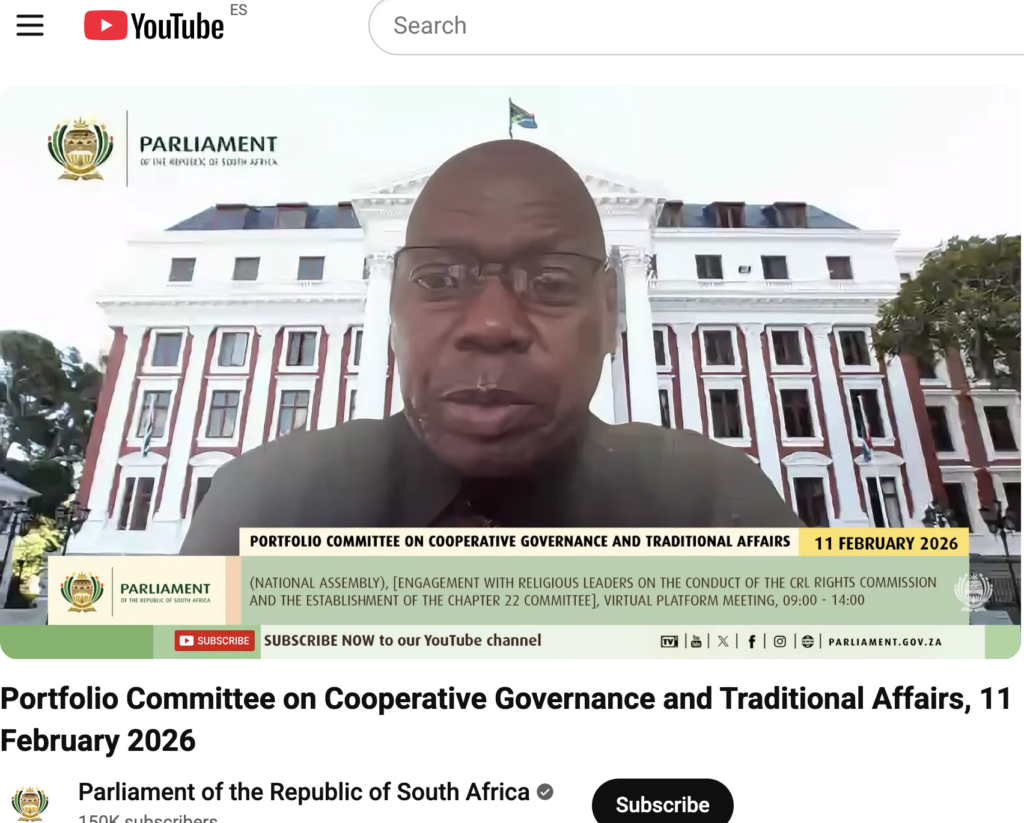
After sustained requests from diverse religious bodies and civil society organisations, the Parliamentary Portfolio Committee on Cooperative Governance and Traditional Affairs (PC COGTA), which has oversight over CRL and had rejected its earlier recommendations in 2018, convened an online meeting to hear concerns regarding the CRL Chair’s continued push toward State regulation of religion. The CRL had in October 2025 set up a sub-committee “for the Christian sector” with the task to consult churches on “self-regulation” while simultaneously seemingly predetermining the desired results of that process. This Committee is named after Section 22 of the CRL Act which allows it to form sub-committees.
This was the first formal opportunity for faith communities to address Parliament directly on the matter. The message delivered to the PC COGTA was clear and unequivocal: there is no support among faith communities represented at that meeting for legislation to regulate religion.
[Recording starts at minute 25:00; IIRF contribution: 1:41:50–1:45:30.]
Broad-Based Faith Opposition
Although the CRL’s attention has mainly focused on Christianity, submissions were made by a wide spectrum of religious leadership, including Muslim and African traditional spirituality representatives. These leaders expressed serious concern at being unfairly discriminated against by being excluded from the Section 22 Committee process. They warned that any legislative outcome would affect all faith traditions equally.
Stakeholders raised objections relating to inclusivity, religious representation, the purpose and constitutional basis of the Section 22 Committee, and the risk of eventual state regulation of religious institutions.
While unequivocally condemning abusive or criminal conduct within religious settings, faith leaders emphasised that such conduct must be addressed through existing criminal and civil laws, not through new regulatory legislation targeted at religion.
A Constitutional Issue
The leading advocacy group Freedom of Religion South Africa (FOR SA) in its presentation framed the matter squarely as a constitutional question.
“This is fundamentally a constitutional issue,” said Michael Swain, Executive Director of FOR SA. “Abuse and exploitation are crimes. They must be prosecuted effectively and without hesitation by the State. Creating additional legislation to regulate religion is neither necessary nor constitutionally permissible, particularly where viable alternative solutions already exist and have been proposed.” Swain affirmed that South Africa’s legal framework is extensive and robust, and that any erosion of the right to freedom of religion through unnecessary legislative intervention would be unacceptable. “There are practical, workable alternatives already in place,” he added. “The Constitution requires that the least restrictive means be used. That threshold has simply not been met.”
Academic Evidence Challenges CRL Claims
Senior international scholars and legal experts contributed to the discussion. Professor Christof Sauer of the International Institute for Religious Freedom (IIRF) presented research refuting the CRL Chair’s claim that Section 22 Committee members represent 40 to 45 million Christians. He further questioned the assertion that abuse and criminality within the faith sector are systemic, widespread or increasing, and demanded that the CRL present clear evidence from complaints it might have received over the years within its mandate.
Sauer also reminded PC COGTA about the prior attempt by CRL to regulate religion (2015–2019), which equally encountered massive rejection by religious communities and which Sauer had critically examined in a published article. He futher pointed to the outcomes in 2020 of an earlier COGTA PC hearing with religious communities on harmful religious practices, where Sauer was commissioned to summarise the suggestions made to deliberate on the way forward.
Professor Rassie Malherbe, representing the South African Council for the Promotion and Protection of Religious Rights and Freedoms (CRRF) presented the South African Charter of Religious Rights and Freedoms (2010) and the Code of Conduct for Religions in South Africa (2019) “as a sound basis for the effective combat of malpractices and the development of healthy practices within the religious sector”. The CRL has demonstrated disinterest in these instruments developed by religious communities themselves and insists on developing new ones in a process designed and controlled by the CRL.
Nonetheless, here was unanimous agreement among all presenters that any criminal misconduct within religious institutions must be addressed decisively through South Africa’s existing legal mechanisms.
Calls for Accountability
Several submissions called for scrutiny of the conduct of the CRL Chair, Mrs Thoko Mkwanazi-Xaluva. Faith leaders expressed concern over what they described as disparaging remarks directed at Christian communities and the exclusion of major religious bodies from meaningful participation in the Section 22 process.
These concerns were reinforced by an affidavit from former Section 22 Committee Chair, Professor Reverend Musa Xulu, who stated that the Committee “is being used as a front to disguise a predetermined agenda of State control of religion, driven in part by personal hostility toward particular Christian faith and traditions.”
Concerns were also raised about divisions within faith structures. The Evangelical Alliance of South Africa (TEASA), which has supported the CRL Commission’s agenda, has faced significant internal repudiation from member bodies. The Apostolic Faith Mission (AFM) has already withdrawn its membership, and other major denominations have indicated that they may follow.
PC COGTA Response
Following the engagement, the PC COGTA issued a media statement reaffirming two core principles: that freedom of religion is constitutionally guaranteed and must be protected, and that congregants must be safeguarded from abuse.
Committee Chairperson Dr. Zweli Mkhize confirmed that the Committee is actively engaging the matter, including obtaining a legal opinion and consulting further stakeholders in response to an instruction from the Speaker of the National Assembly to give the issue serious attention.
The PC COGTA indicated that it will assess whether common ground can be found within a constitutional framework, continue consultations with religious bodies, the CRL Commission and the Minister of COGTA, and examine questions relating to the constitutionality of the Section 22 mandate, the adequacy of existing laws, and concerns regarding the Commission’s leadership.
The Committee will conduct further research and engagements before reporting back to the Speaker.
Cautious Optimism
FOR SA is cautiously optimistic about the outcome of the engagement.
“Today demonstrated that faith communities across traditions are united in defending constitutional freedoms while unequivocally condemning abuse,” said Swain. “We are encouraged that Parliament has taken these concerns seriously. However, we will remain vigilant. The constitutional protection of faith and freedom must not be eroded through unnecessary and constitutionally unjustifiable legislation.”
FOR SA extends its appreciation to the many leaders, scholars and community representatives who participated and continue to stand in defence of constitutional rights.
This press release has been adapted and expanded from a press release published by FOR SA on 13 February 2026.
Documents
- Original Press Release by FOR SA 13 February 2026
- Press Release by COGTA PC 11 February 2026
Video recording of the COGTA PC hearing on 11 February 2026 [Recording starts at minute 25:00; IIRF contribution: 1:41:50–1:45:30.] - Minutes of the COGTA PC hearing on 11 February 2026 produced by the Parliamentary Monitoring Group (PMG) including documents submitted
- CRL Rights Commission: Draft self-regulatory framework for the Christian sector in the Republic of South Africa prepared for the CRL Rights Commission by Section 22 Ad Hoc Committee (21 December 2025, Draft V2)
- FORSA Presentation to the Portfolio Committee on Cooperative Governance and Traditional Affairs 11 February 2026
- FORSA Submission: Alternative Solution to State Regulation of Religion: A position paper for consideration by faith communities and the CRL Rights Commission Prepared by Freedom of Religion South Africa (FOR SA) Updated November 2025
- Letter by the South African Council for the Promotion and Protection of Religious Rights and Freedoms 11 February 2026
- South African Church Defenders: Submission to the Portfolio Committee on the Conduct of the CRL Rights Commission and the Section 22 Process (11 February 2026)
- Western Cape Religious/National Faith Delegates: Letter to Speaker of National Assembly demanding Investigation of CRL Chair Mrs. Mkgwanzani-Xuluva and proposals to regulate religion
IIRF Documents
- Christof Sauer: Recommendations by IIRF to the Portfolio Committee on Cooperative Governance and Traditional Affairs at the Engagement with religious leaders on concerns raised about the conduct of the CRL Rights Commission and the establishment of the Section 22 Committee on 11 February 2026
- Draft suggestions to the COGTA Committee Presented by Prof. Dr. Christof Sauer to deliberate on the way forward and making statements or taking resolutions on the occasion of the Indaba with religious communities on harmful religious practices 11 March 2020
- Christof Sauer: Safeguarding freedom of religion or belief: Assessing the recommendations of the CRL Rights Commission in light of international human rights standards.