
On 22 September 2026, IIRF scholars Dr Dennis P. Petri, Dr Camila Sánchez-Sandoval and Marcela Bordón-Lugo published “Religious Freedom for Whom? Ecclesiocentrism in the Design and Implementation of Colombia’s Public Policy on Religious Freedom” in the journal Religions. The article offers a critical analysis of Colombia’s Comprehensive Public Policy on Religious Freedom and Worship (PPRF) and will be of interest to anyone working on the relationship between religious freedom and public policy.
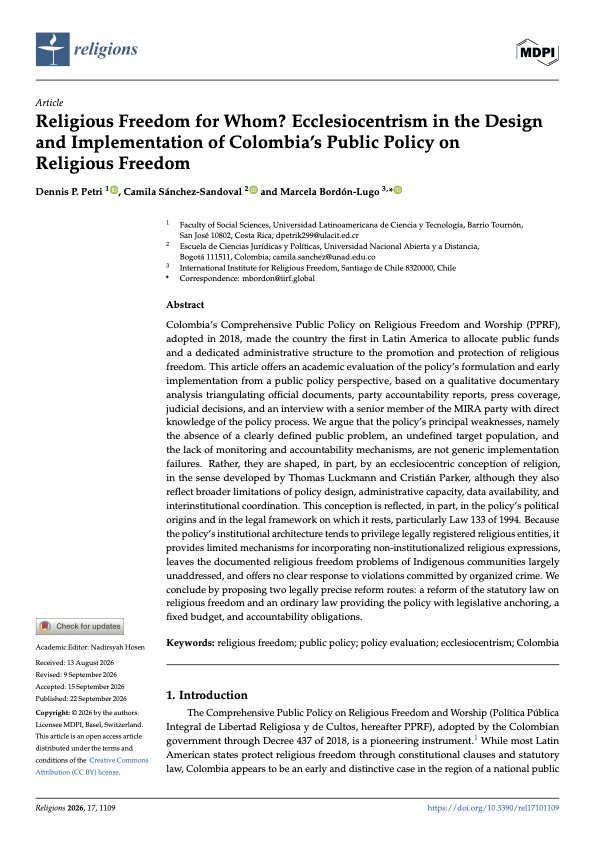 The PPRF is a pioneering policy in Latin America, one of the few in the region designed specifically to promote religious freedom. The authors trace how the policy was conceived and assess its early implementation, and they find conceptual weaknesses that limit both its effectiveness and its reach. The policy does not clearly define the public problem it seeks to address, does not identify a target population, and lacks mechanisms for monitoring and accountability. As a result, it is conceptually weak and inconsistently applied.
The authors argue that these weaknesses stem in part from the ecclesiocentric framework in which the policy was designed, one that treats organised churches as the primary subjects of religious freedom. This leaves the PPRF poorly equipped to protect the religious freedom of non-Christian communities, most notably Indigenous religiosity and spirituality.
The article sets out how the policy’s origins shaped its conceptual scope, examines the practical difficulties it faces in implementation, and proposes two complementary routes for addressing its conceptual weaknesses. The authors contend that these changes would give Colombia a comprehensive framework that protects religious freedom for all, regardless of shifts in the political climate.