
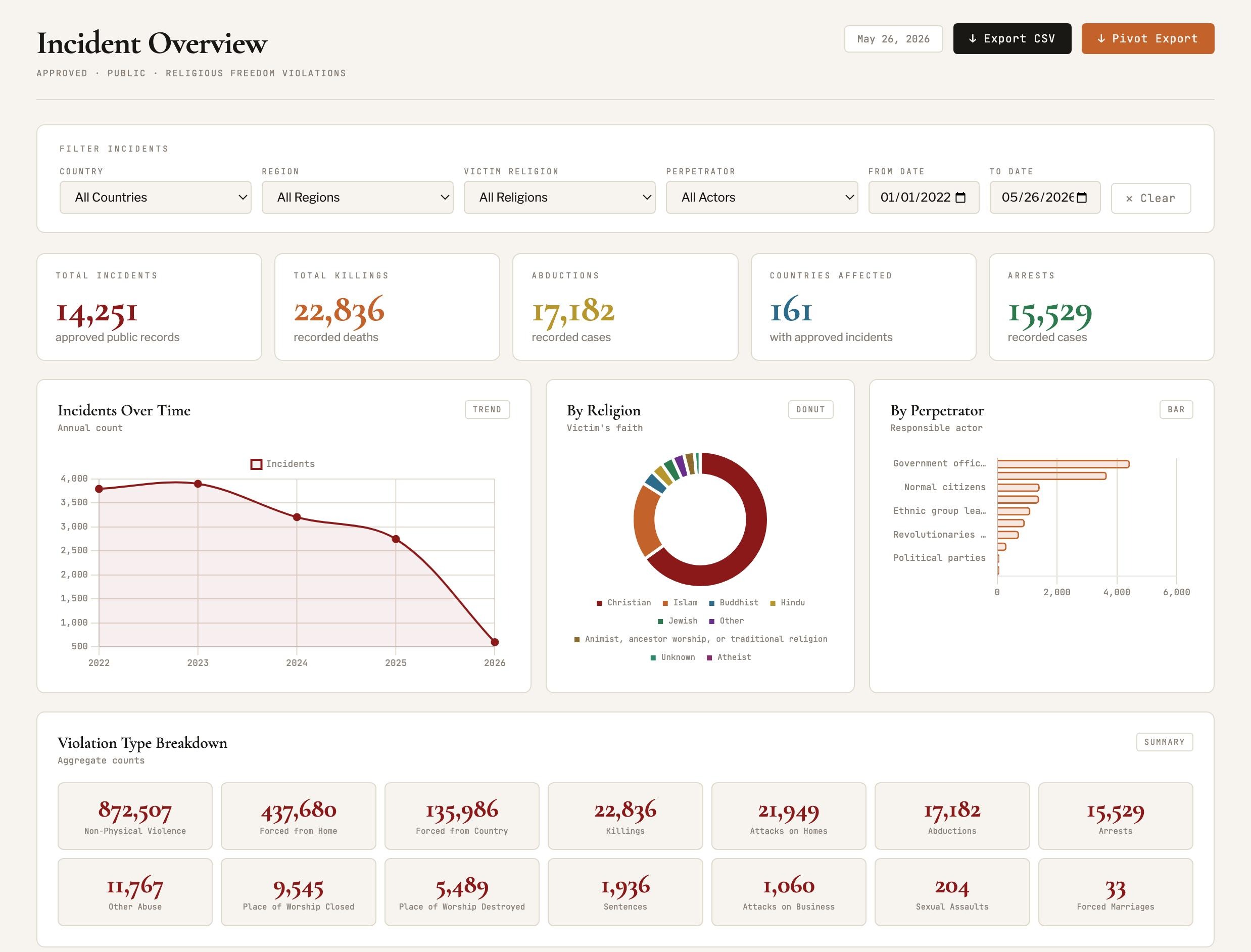
Every field of human rights advocacy eventually learns the same lesson: what does not get counted does not get addressed. Governments respond to numbers. Journalists cite numbers. Courts and UN bodies weigh numbers. For most human rights violations, sophisticated event datasets have existed for years. For violations of freedom of religion or belief, there is exactly one comprehensive, incident-level dataset in the world: the Violent Incidents Database (VID) of the International Institute for Religious Freedom.
Today I want to tell you how it came to be, how it works, what it has achieved, and why its future is now in question.
More than a decade in the making
The VID began with a challenge. In 2011, Thomas Schirrmacher called for the systematic documentation of cases of religious persecution, arguing that the field relied too heavily on impressions and anecdotes. That call stayed with me. In 2014, while still working for a charity, I began building the VID as a personal initiative. When I founded the Observatory of Religious Freedom in Latin America (OLIRE) in 2017 and 2018, I took the database there, and with our team we kept it updated for Latin America. When I joined the IIRF in 2021, we made it global, and the VID became the Institute’s flagship empirical resource. Ronald MacMillan, our current Chairman, ensured sufficient funds that expanded its reach and allowed us to offer it open access at first; but when that funding came to an end, we had to transition to a subscription model. Today the VID holds more than 18,000 documented records spanning more than 60 countries, and it grows every month.
How it works
Most religious freedom measurement tools rely on expert opinion, coded narratives, or population surveys. These are valuable, but they share a weakness: they tell you how bad things are perceived to be, not what actually happened, where, and to whom.
The VID takes a different approach. It records discrete, verifiable events: killings, abductions, arrests and detentions, attacks on places of worship, forced displacement, sexual violence, and other categories of harm. Each record captures the nature of the incident, its location down to the subnational level, the religious identity of victims and, where ascertainable, of perpetrators, together with sourced evidence. Trained researchers monitor assigned regions using curated lists of credible sources, from wire services to human rights organizations and official reports.We are transparent about what this can and cannot promise. With thousands of incidents per year, no team could independently verify every event before publication; anyone who insists on that standard will either never publish or never start a project this ambitious.
The VID therefore works on the principle of a posteriori falsification: every record is fully sourced, and whenever a user or researcher flags an incident as incorrect, we review it and correct or remove it. It is the same logic that keeps science honest, applied to human rights documentation.Since 2021, we have also automated a large part of the data collection and categorization using artificial intelligence and machine learning, with our researchers concentrating on curation and quality control. This has made the operation run very efficiently, and it underpins something no other resource in this field offers: the promise of near real-time information on religious freedom violations. Nobody else provides that.The result is granularity no other FoRB dataset offers. Fewer than five percent of records lack subnational geographic detail, which means the VID can show, for example, how violence in Colombia varies dramatically between departments even when national-level indices see a stable picture.
This methodology is not a black box: it has been through full peer review and is published open access in the journal Data.This is not only my assessment. Dr. Ariel Zellman, a political scientist at Bar Ilan University, writes that the VID’s incident-level reporting offers “an unprecedented level of detail to unpack macro and micro-dynamics of religious violence on a global scale,” with an appreciation of context that larger projects “whose data collections rely upon data scraping and probabilistic coding” are unable to match.
What it has achieved
In 2024 alone, the VID documented 2,956 incidents affecting 421,351 victims. My colleagues and I have taken the VID around the world, presenting it to governments, universities, and civil society organizations, and it has been used in countless publications, including in top tier academic journals. The database has been cited by the United States Institute of Peace, referenced in two U.S. State Department country reports, featured in a UN Human Rights Council UPR report on Nigeria, and presented at the IRF Summit in Washington, D.C., where it continues to spark interest in policy circles. Its findings have also unsettled comfortable assumptions in the scholarship, for instance by showing organized crime as one of the most frequently recorded perpetrator categories of religiously targeted violence, a factor much of the literature had minimized.
Scholars working on exactly that frontier confirm it. Dr. Radha Sarkar, an assistant professor at the Tecnológico de Monterrey, describes the VID as “an invaluable resource for my research on organized crime against religious actors in Mexico” and as the only resource she knows of that collects event-level data on such a wide variety of religious actors across two decades; she and her co-authors used it as the foundation for a municipality-level dataset of their own. In Colombia, Martha Inés Alarcón Carrera, a doctoral researcher at La Salle University in Bogotá, calls the VID “an invaluable tool” for her dissertation on religious freedom violations, one that allowed her to identify hotspots of recurring incidents and to distinguish violations driven by armed control and illegal economies from those linked to urban conflict.Behind each of those records is a person: a pastor abducted, a church burned, a community displaced. The VID exists so that their experiences enter the historical record and the policy conversation, rather than vanishing into anecdote. Dr. Yves Solís, a historian at Universidad Iberoamericana in Mexico, makes that point through a single case: the June 2022 murders of Jesuit priests Javier Campos Morales and Joaquín César Mora Salazar, together with tour guide Pedro Palma Gutiérrez, inside the church of Cerocahui, Chihuahua, by the Sinaloa Cartel’s regional boss in Urique. The case shocked Mexico, yet as Solís observes, countless similar victims receive at most “a news story that quickly disappears.” Documentation is what keeps them visible, and he credits the VID team with something no algorithm can replicate:
“the trust it has built with affected communities, granting access to detailed information that would otherwise be impossible to obtain.”
The candid part
Here is what I need to say plainly: the VID is critically underfunded. The IIRF has built and maintained this resource for years on limited means, and we are running out of runway. Without new revenue, the only global incident-level dataset on religious freedom violations will stop being updated. More than a decade of accumulated documentation infrastructure, researcher training, and institutional knowledge would be extraordinarily difficult to rebuild.
Let me be explicit about what is at stake, because it is more than a dataset. When documentation stops, victims do not stop suffering; they stop being counted, and uncounted suffering is suffering that policy ignores. A pastor abducted in a region nobody tracks generates no diplomatic inquiry, no protection program, no line in a country report. Perpetrators read that silence accurately, as impunity. Advocacy and legal resources flow toward the violations that are documented, which means every gap in the record quietly redirects help away from the people who need it most. If the VID goes dark, the violence it records will continue exactly as before. The only thing that disappears is the world’s ability to see it.We have chosen a sustainability model that keeps the mission intact: subscriptions. Summary data tables and IIRF reports remain free to the public. But full access to the live VID dashboard, with all incident records, advanced filtering by country, region, religion, and incident type, CSV and Excel export, and pivot table analysis, is now offered through annual subscriptions.
Two tiers cover most readers of this newsletter. The Researcher tier, at US $1,500 per year, gives individual academics, graduate researchers, and small NGOs full dashboard access with export and analysis tools. The Organizational tier, at US $4,000 per year, adds three user seats, quarterly data briefings, an annual webinar with the VID research team, and priority support; it is designed for mid-size NGOs, advocacy organizations, research centres, and denominational bodies. We priced these deliberately below comparable conflict-data subscriptions because we want researchers to use this data.For universities, large INGOs, foundations, and think tanks there is an Institutional tier at US $10,000, and for embassies, foreign ministries, and multilateral bodies there are government tiers from US $30,000 upward, with custom analytical briefs, dedicated support, and API access. And because the communities most affected by persecution should never be priced out of the evidence that serves their own protection, our application-based Mission Access track provides free or heavily subsidized access to persecution documentation groups and Global South researchers without institutional funding.
What you can do
Before I make the ask, let others make it for me. Marcela Szymanski, head of international advocacy at Aid to the Church in Need and editor of its report “Religious Freedom in the World” from 2015 to 2023, puts it plainly:
“I strongly recommend supporting the VID development.”
And Solís frames the decision exactly as I would want it framed:
“A subscription is not simply about gaining access to data that can help researchers understand the dynamics of violence. It also means supporting an organization that builds trust with affected communities, analyzes the information it collects, produces reports, and makes knowledge available to researchers, policymakers, and affected populations themselves.”
If you are a researcher, subscribe. If you work at an NGO, a university, or a ministry, put the VID in next year’s budget and forward this post to whoever decides. If you are neither, share this with someone who is. Every subscription directly funds the researchers who verify each incident, one record at a time.To subscribe or request a conversation about the right tier for your organization, write to info@iirf.global or visit https://iirf.global/vid/. The VID took more than a decade to build. Keeping it alive is far cheaper than starting over.