
For the last several years, the religious freedom community has described Nigeria as the most dangerous country in the world in terms of the number of Christians dying due to persecution. Open Doors, a leading research organization, reported that in 2025, of the approximately 5,000 Christians identified as having died for their faith, 3,490 died in Nigeria.
Much debate has occurred over the reasons for this tragic situation. Unfortunately, the debaters have usually had little or no empirical data available to them.
In a new report, our deputy director, Kyle Wisdom, drew on the IIRF’s Violent Incidents Database to assess more accurately the causes for the scourge of killings and abductions in Nigeria.
Wisdom found that 4,720 individuals were killed and 4,160 abducted in 1,924 incidents in Nigeria from January to September 2025. He also found that the incidents fall into four distinct groups, based on their motivation and geographic location.
The world is rightly appalled by the horrible actions of Islamic jihadist insurgents such as Boko Haram and ISWAP (Islamic State West Africa Province). But the world has significant misconceptions about these incidents. Of the 719 people killed in 198 such incidents, 52 percent were Muslims. These jihadists are using roadside devices and bombings to kill indiscriminately whoever is present. They are not targeting Christians specifically. These incidents occur overwhelmingly in Nigeria’s North East region.
The vast majority of abductions occur in the North West region and have primarily economic motivations. Bandits and militias take hostages in order to obtain ransom payments. From January to September 2025, 3,075 people were abducted in Nigeria and 1,510 were killed. Since corpses do not generate ransoms, killings happen only to apply pressure for the ransom of other abductees, deter pursuit, or punish nonpayment. In the North West region, 65 percent of victims were Muslims.
The largest number of deaths—1,838, along with 460 abductions—is attributable to land disputes, generally between Fulani Muslim herders and mostly Christian farmers. Most of the worst incidents involve nighttime attacks on farming settlements. These events generally occur in the Middle Belt region of north central Nigeria.
Finally, 617 people were killed and 384 abducted in southern areas of the country. Fifty-four incidents specifically involved clergy, resulting in 109 killings and 104 abductions. The targets are overwhelmingly Christian, but that fact generally reflects the predominantly Christian population and the attractiveness of religious leaders as targets, not necessarily religious persecution.
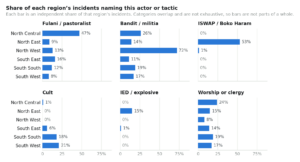
Note: The percentages listed for each region in the table above do not necessarily add to 100 percent, because some incidents involve more than one of the listed actors or tactics (e.g., some North East incidents involve ISWAP or Boko Haram and an IED or explosive) and some incidents do not involve any of these features.
This breakdown of incidents has clear implications for advocacy and policy. For example, although the U.S. bombings of terrorists in the North West region may have had some impact, a serious commitment to eradicating jihadism would need to focus on the North East area, where most of these groups are located. The most lethal threat to religious freedom is the assaults on Christian settlements in the Middle Belt. The ransom economy in the North West is clearly not motivated by religious persecution, as 65 percent of the victims in this predominantly Muslim region are themselves Muslims, and should not be depicted as such.
We believe that if advocates and policymakers pay attention to the evidence provided by our Violent Incidents Database, they will be more successful in preventing violence and building a more peaceful Nigeria.