
The International Institute for Religious Freedom (IIRF) mourns the loss of Prof. Dr. Pieter Coertzen, a distinguished South African theologian and church law expert from Stellenbosch, who passed away on 11 March 2026. Pieter Coertzen was one of the vital members of the Academic Board of the International Institute for Religious Freedom, as well as of the Editorial Board of the International Journal for Religious Freedom (IJRF).
Academic Career
Born on 20 April 1943 in the mining town of Boksburg in Gauteng province, South Africa, Pieter Coertzen earned multiple degrees cum laude from Potchefstroom University and the University of Stellenbosch, including a doctorate in ecclesiology in 1976. He served as Senior Lecturer of Church History at the Faculty of Theology of Stellenbosch University from 1977, became Professor in 1988, Head of the Department of Systematic Theology and Ecclesiology, and Dean of Theology from 1995 to 1997. After retiring in 2004, he seamlessly continued as Extraordinary Professor in Comparative Church Law at Stellenbosch and in the Faculty of Canon Law of the Catholic University of Louvain, Belgium.
Church Service
Before entering academia, Coertzen ministered in parishes of the Dutch Reformed Church in Dundee and Potchefstroom (1970–1976), later serving as associated minister in Franschhoek (1995–2008). He advised on church law as actuarius for provincial and national Dutch Reformed Church synods from 1991 to 2004.
Scholarly Legacy
A prolific author, he published numerous articles in various journals, alone 36 in the Dutch Reformed Theological Journal (NGTT) which he edited for many years. He authored 14 books including “The Huguenots of South Africa 1688–1988” and “Decently and in order: A theological reflection on order for and in the church” (both originally published in Afrikaans), plus 26 co-authored works, many translated into English. His expertise profoundly shaped the discourse on religious freedom, particularly in South Africa’s transition to democracy. Through edited volumes like “Law and Religion in Africa: The Quest for the Common Good in Pluralistic Societies”, he explored tensions between church autonomy, state regulation, and human rights in diverse societies, advocating for balanced legal frameworks that protect faith communities while upholding constitutional pluralism.
South African Charter of Religious Rights and Freedoms
Coertzen was not only a theologian of religious freedom, but a key architect and steward of the South African Charter that continues to shape how religious communities understand and exercise their rights in a plural, post-apartheid society.
Pieter Coertzen played a central and defining role in the development of the South African Charter of Religious Rights and Freedoms, going far beyond mere academic interest in the topic. He led the group of religious leaders, theologians, and lawyers that drafted the Charter from 2008 to 2010.
In this capacity he shaped the document’s theological depth, its legal rigor, and its ecumenical and inter-religious character, ensuring that it reflected the convictions and concerns of a broad spectrum of faith communities. His work on the Charter and the accompanying “Explanatory Note” helped translate the constitutional right to freedom of religion into a practical, agreed-upon framework that religious institutions themselves could own and promote in South African society.
The International Institute for Religious Freedom and the director of its Cape Town Bureau were among those who critically engaged with the initial draft, brought in international experience with codes of ethics, attended meetings, and endorsed the final version of the Charter, and propagated it through its International Journal for Religious Freedom.
Later, after the Charter had been adopted, Coertzen served as convener of the “South African Council for the Protection and Promotion of Religious Rights and Freedoms”, the body established by religious institutions to give concrete effect to the Charter. In this leadership role he coordinated between different faiths, represented the Council in public and policy debates, and helped ensure that religious freedom would be defended not only in courtrooms but also in schools, workplaces, and public discourse.
He also authorised the development of the “Code of Conduct for Religions in South Africa” in 2017, based on the Charter to promote greater voluntary accountability within religious communities, though health constraints prevented his continued personal involvement.
On this matter Coertzen and other members of IIRF stood side by side over the years opposing the attempts of imposing regulation of religion by the Commission for the Promotion and Protection of the Rights of Cultural, Linguistic Communities (CRL Rights Commission), an entity mandated by the South African Constitution.
Involvement with IIRF
Christof Sauer, one of the founding directors of IIRF, then based in Cape Town, South Africa, remembers: “Prof. Coertzen had just been forced to retire as professor of the Theological Faculty in Stellenbosch in 2004 at the age of 60, due to some new law or regulation. Around that time I was involved in helping organize the annual conference of the Southern African Missiological Society held in Stellenbosch in January 2005. Thus, when the International Institute for Religious Freedom started to evolve from 2005, with one of its seats in Cape Town, it was natural to seek cooperation with Prof. Coertzen. Coertzen was busy developing the ‘Unit for the Study of Law and Religion’ as part of the ‘Beyers Naudé Center for Public Theology’ of the Theological Faculty in Stellenbosch.”
In due course Coertzen became a member of the Academic Board of IIRF, and also of the Editorial Board of the International Journal for Religious Freedom (2011–2023).
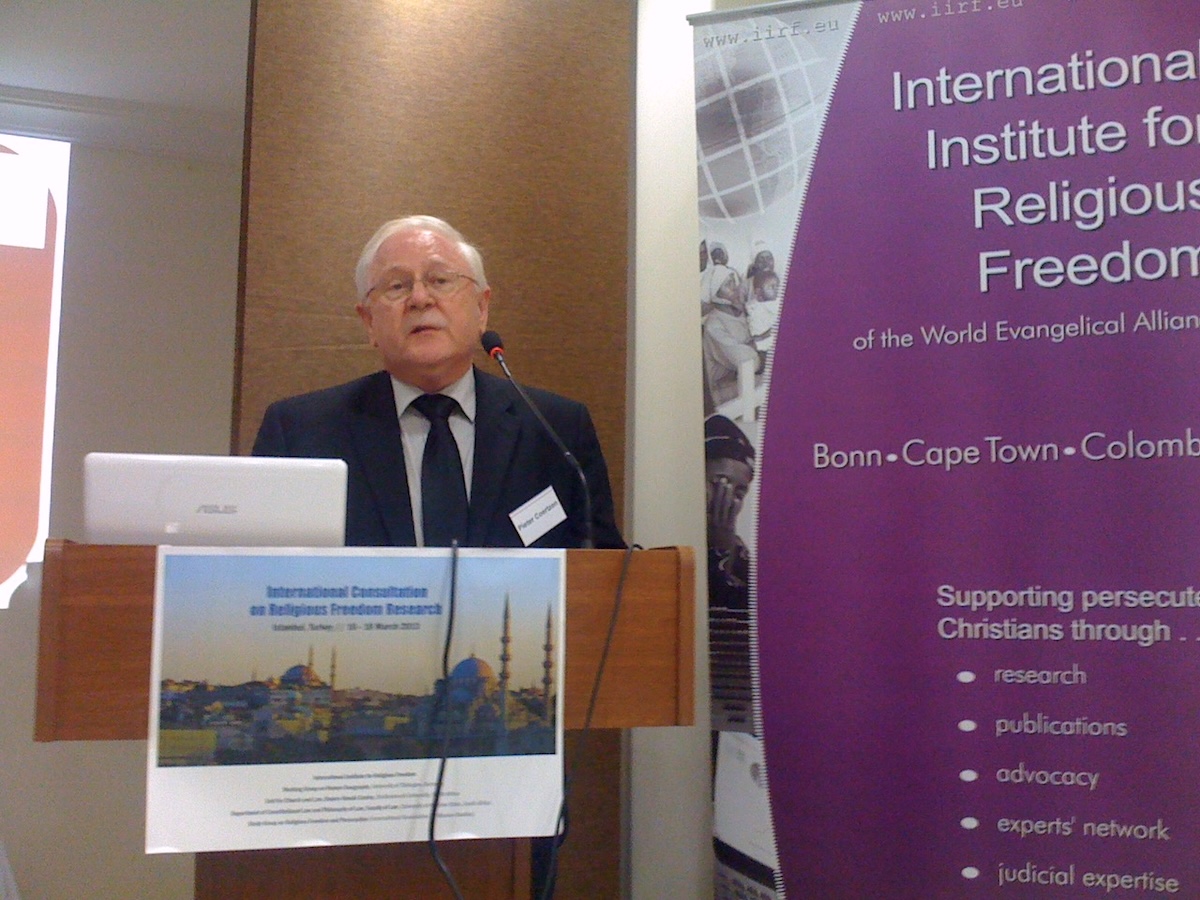
In 2013 Coertzen also participated in the IIRF’s first International Consultation on Religious Freedom Research held in Istanbul, addressing the effects of the South African Charter of Religious Rights with regard to the major religions in South Africa and their institutions.
ICLARS and ACLARS
Coertzen’s academic interest in freedom of religion or belief was deeply intertwined with the International Consortium for Law and Religion Studies (ICLARS) and he was part of its leadership. He further was instrumental in founding the corresponding African entity, ACLARS, in 2014. In May 2014 Coertzen organized the Second Conference on Law and Religion in Africa, held at Stellenbosch University. The African Consortium for Law and Religion Studies (ACLARS) was officially launched there, with Prof. Coertzen as President (2014-2019). Sauer recalls: “The contact with Prof. Coertzen paved the way for my own participation in multiple conferences of ICLARS and ACLARS since 2014. This hugely contributed to making the IJRF and the academic book series of IIRF known among scholars of law and religion internationally.”
Forum
Prof. Coertzen, likely as a result of his connection with Prof. W. Cole Durham Jr. (president of both ICLARS and IF20) also became a member of the Advisory Board of the G20 Interfaith Forum Association (IF20) that mobilizes religious wisdom, scholarly expertise, and global networks to shape solutions for today’s most urgent public policy challenges. In 2015 Coertzen addressed the “Regional Panel on Interfaith in the Asia-Pacific” in a session on religion or faiths and sustainable development.
Expert on Huguenot History in South Africa
Prof. Pieter Coertzen also made significant contributions to Huguenot studies through his authoritative book “The Huguenots of South Africa 1688–1988”, published in both Afrikaans and English in 1988 to mark the tricentenary of the Huguenots’ arrival in South Africa. It offers a pictorial and historical overview of Huguenot families from their French Reformed Church roots in 1559 through their settlement and integration into South African society. This work solidified his role as a key scholar on the Huguenots’ cultural, religious, and demographic legacy in the region. He was a board member and some time chair of the Huguenot Society of South Africa (1988–2018) and chairing the board of the Huguenot Memorial Museum in Franschhoek near Stellenbosch (1988–2010) and involved in leadership of related entities.
Thus, it was natural that Coertzen became one of three members of the Academic Council advising the Library of Huguenot History, an independent branch of the IIRF. The Bibliothek für Hugenottengeschichte (BFHG), as it is called in German, was founded in 2008 by Daniel Röthlisberger, a Swiss-German researcher, with a deep interest in connecting historical interest in the persecuted Huguenots with experiences of contemporary Christians under pressure for their faith. He recalls: “I enjoyed the academic expertise of Prof. Coertzen.”
The International Institute for Religious Freedom and its staff gratefully treasure the memory of Prof. Dr. Pieter Coertzen as a stalwart in academic, societal and historical engagement with religious freedom in the context of law and religion.
Further Downloads and Links
- Janet Epp Buckingham. “Why and how to protect religious freedom: A report on the International Consultation on Religious Freedom.” Istanbul 2013.
Religious freedom in South Africa
- Iain T. Benson. “South African Charter of Religious Rights and Freedoms: Constitutional framework, formation and challenges.” IJRF 4/1, 2011.
- South African Charter of Religious Rights and Freedoms and Code of Conduct for Religions in South Africa (with cover letter by Prof. E. Malherbe on contemporary context).
- Exploring a Code of Conduct
- FOR SA
- Interview with Prof. Coertzen on the South African Charter of Religious Rights and Freedoms (2013)
African and International
- https://www.strasbourgconsortium.org/content/blurb/files/ICLARS%20Leadership.pdf
- https://www.iclrs.org/blurb/the-second-conference-on-law-and-religion-in-africa-stellenbosch-south-africa-2014/
- Video of presentation by Prof. Coertzen at ACLARS (2015)
- CV published by G20Interfaith Forum
- Video of Prof. Coertzen presentation 18 November 2025 G20Interfaith Forum
- https://www.g20interfaith.org/japan-recommendations/
Huguenots
- Hugenote Vereniging van SA: Obituary 11 March 2026
Academic and literary output
- Stellenbosch University, Theological Faculty, Department of Systematic Theology and Ecclesiology
- Supervision of academic work
- Research Gate
- Stellenbosch Writers (2004)
- Google Scholar
- WorldCat
Websites of other entities mentioned
- Gerdrie van der Merwe in Kerkbode [Paper of the Dutch Reformed Church] 19 March 2026 [Afrikaans]
- Dutch Reformed Church in South Africa
- Franschhoek
- KU Leuven
Essays on the South African Charter of Religious Rights and Freedoms
- Pieter Coertzen, “Grappling with Religious Differences in South Africa: A Draft for a Charter of Religious Rights”, Brigham Young University Law Review, 3(2008), 779–806.
- Rassie Malherbe, “The Background and Contents of the Proposed South African Charter of Religious Rights and Freedoms,” Brigham Young University Law Review, 3(2011), 613–635.
- Iain T. Benson, “South African Charter of Religious Rights and Freedoms: Constitutional framework, formation and challenges”, International Journal of Religious Freedom, Vol. 4, 1(2011), 125–134.
- Iain T. Benson, “Religious Interfaith Work in Canada and South Africa with Particular Focus on the Drafting of a South African Charter of Religious Rights and Freedoms,” HTS Teologiese Studies/Theological Studies, Vol. 69, 1(2013), 1–13.
- Pieter Coertzen, “Constitution, Charter and Religions in South Africa,” African Human Rights Law Journal, Vol. 14, (2014), 126–141.
- Iain T. Benson, “Subsidiarity: Origins and Contemporary Aspects”, in N. Aroney & I. Leigh (Eds), Christianity and Constitutionalism, (Oxford: Oxford University Press, 2022), 432–454.
- Rassie Malherbe, “The South African Charter of Religious Rights and Freedoms”, The Review of Faith & International Affairs, Vol. 22, (2024), 93–104.
- Shaun de Freitas, “Liberty of Association and a Charter for Religious Rights and Freedoms”, Journal of Church and State, Vol. 67, 4(2025), 1–10.